Published: May 14, 2025
Editor’s pick
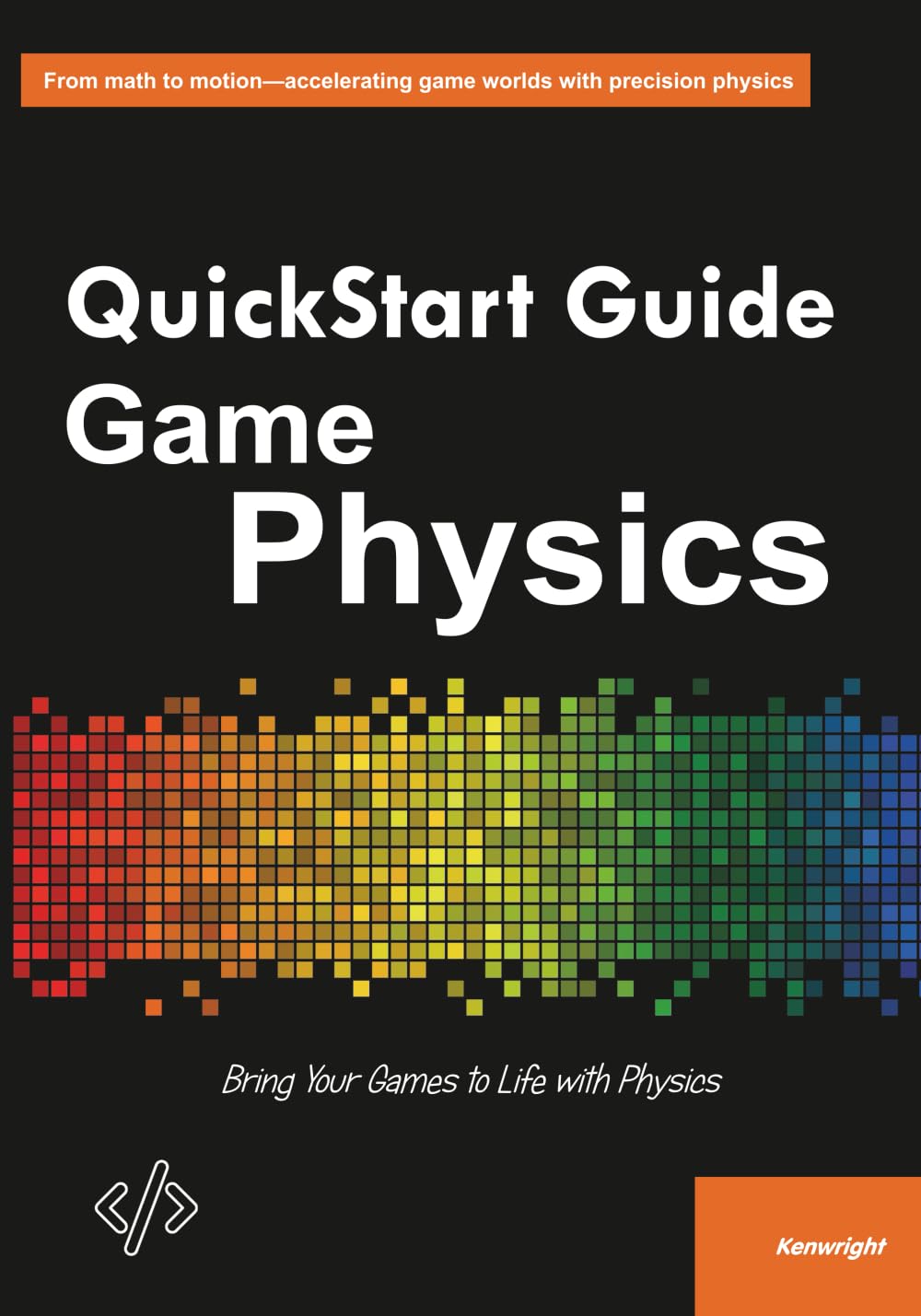
QuickStart Guide to Game Physics
By Kenwright · Computers & Technology · Programming · Game Development · Computer Graphics
A fast-paced, practical introduction to game physics for developers who want to add realism and responsiveness to their games without getting lost in complex math.
What this book actually gives you
Learn how to bring your games to life with physics that feel right—without needing a PhD in math.
This book is your shortcut to understanding and implementing game physics. Whether you're building a platformer, a racing sim, or a physics-based puzzle game, you'll learn how to simulate motion, collisions, gravity, and more. With clear examples and minimal math, this guide helps you create gameplay that feels responsive, believable, and fun. Ideal for developers who want results fast and aren't afraid to get hands-on.
You’ll especially enjoy this if you want to…
- Understand core physics concepts used in games.
- Implement realistic movement and collisions with minimal code.
- Avoid common pitfalls that make physics feel off.
- Accelerate your development with ready-to-use examples.
Where this fits in your learning path
Use this book after you’re comfortable with basic syntax but before you dive into highly specialized papers or production frameworks.
Many readers pair it with online courses or tutorials—using the book to deepen concepts and the course to provide structure and deadlines.
Community reviews & nested discussion
Positive, experience-driven impressions of QuickStart Guide to Game Physics—written in different voices so you can quickly see whether this matches your learning style.
Maya, Senior Engineer
Aug 16, 2026My new desk-side reference for Game Physics
I picked up QuickStart Guide to Game Physics expecting a quick overview and instead found a book I’ve already highlighted to pieces. The explanations of Game Physics are concrete and practical without losing the big-picture view.
What I like most is how each chapter ends with small experiments you can run on your own projects. It feels less like “homework” and more like a mentor nudging you to try one more idea. I’ve already refactored an old prototype using techniques from the first three chapters and the performance gains were obvious.
If you care about writing code that ages well instead of quick hacks, this belongs within reach of your keyboard.
Reply from the community
Aug 16, 2026Totally agree. I had a similar experience with QuickStart Guide to Game Physics—especially the parts on Game Physics. It’s rare to find a book that balances clarity, depth, and real-world trade-offs this well.
Coffee-powered reader
Aug 16, 2026I keep a sticky note inside the chapter I’m currently on. When I get stuck on a bug, I flip back to QuickStart Guide to Game Physics, make a fresh coffee, and usually spot something I missed.
Leo, Curious Student
Aug 17, 2026Finally a book that doesn’t talk down to beginners
QuickStart Guide to Game Physics manages a neat trick: it treats you like a beginner *and* like an adult. I never felt lost, but I also never felt the author was wasting time on fluff.
I read a chapter each evening with a cup of coffee and tried the small code exercises on my laptop. The mix of diagrams, code snippets, and real-world analogies really helped the ideas stick, especially around Collision Detection.
If you’re self-taught or coming from another field, this is the kind of book that makes the advanced topics feel surprisingly normal.
Reply from the community
Aug 17, 2026Totally agree. I had a similar experience with QuickStart Guide to Game Physics—especially the parts on Game Physics. It’s rare to find a book that balances clarity, depth, and real-world trade-offs this well.
Coffee-powered reader
Aug 17, 2026I keep a sticky note inside the chapter I’m currently on. When I get stuck on a bug, I flip back to QuickStart Guide to Game Physics, make a fresh coffee, and usually spot something I missed.
Aisha, Data & Analytics Lead
Aug 18, 2026Bridges the gap between theory and data-on-the-screen reality
So many books on Game Physics stay abstract. QuickStart Guide to Game Physics doesn’t. Every chapter feels like it was written after a long day of debugging real systems.
I appreciated the honest notes about trade-offs: when a slick looking approach will blow up your memory budget, when an elegant algorithm isn’t worth the complexity, and when a “good enough” visualization is actually the smartest choice.
I’ve already recommended it to our new hires as the fastest way to align on vocabulary and best practices.
Reply from the community
Aug 18, 2026Totally agree. I had a similar experience with QuickStart Guide to Game Physics—especially the parts on Game Physics. It’s rare to find a book that balances clarity, depth, and real-world trade-offs this well.
Coffee-powered reader
Aug 18, 2026I keep a sticky note inside the chapter I’m currently on. When I get stuck on a bug, I flip back to QuickStart Guide to Game Physics, make a fresh coffee, and usually spot something I missed.
Sam, Indie Game Dev
Aug 19, 2026Read this with a debugger open and a mug of coffee
As someone who lives in GPU profilers and frame-time graphs, I was pleasantly surprised by how practical QuickStart Guide to Game Physics is.
The sections that touch on performance, debugging weird edge cases, and avoiding “clever but fragile” tricks felt painfully accurate. There are even callouts that feel like the author has personally watched me chase down one-line bugs at 3 a.m.
If your day job involves squeezing the last 5% out of your code, this book will feel like a friendly sparring partner.
Reply from the community
Aug 19, 2026Totally agree. I had a similar experience with QuickStart Guide to Game Physics—especially the parts on Game Physics. It’s rare to find a book that balances clarity, depth, and real-world trade-offs this well.
Coffee-powered reader
Aug 19, 2026I keep a sticky note inside the chapter I’m currently on. When I get stuck on a bug, I flip back to QuickStart Guide to Game Physics, make a fresh coffee, and usually spot something I missed.
Nora, Technical Team Lead
Aug 20, 2026Great for onboarding and setting a shared mental model
I bought QuickStart Guide to Game Physics for myself and ended up buying copies for the team. It’s rare to find a resource that works both for experienced engineers and for people just joining the stack.
We now reference specific chapters during code reviews: “Are we doing the Game Physics thing from chapter 4, or the quick-and-dirty version?” That shared language alone has paid for the book several times over.
If you’re leading a team, consider this a quiet shortcut to better conversations.
Reply from the community
Aug 20, 2026Totally agree. I had a similar experience with QuickStart Guide to Game Physics—especially the parts on Game Physics. It’s rare to find a book that balances clarity, depth, and real-world trade-offs this well.
Coffee-powered reader
Aug 20, 2026I keep a sticky note inside the chapter I’m currently on. When I get stuck on a bug, I flip back to QuickStart Guide to Game Physics, make a fresh coffee, and usually spot something I missed.
Jamie, Lifelong Tinkerer
Aug 21, 2026The rare technical book that’s actually fun to read
QuickStart Guide to Game Physics reads like the author genuinely enjoys the material and wants you to enjoy it too.
There are tiny stories, bug-hunting war tales, and little “coffee break” tips sprinkled throughout. I found myself smiling at the margin notes about common mistakes and “don’t worry, everyone gets this wrong the first time.”
If you code for fun after work and want a book that respects your time and energy, this is an easy recommendation.
Reply from the community
Aug 21, 2026Totally agree. I had a similar experience with QuickStart Guide to Game Physics—especially the parts on Game Physics. It’s rare to find a book that balances clarity, depth, and real-world trade-offs this well.
Coffee-powered reader
Aug 21, 2026I keep a sticky note inside the chapter I’m currently on. When I get stuck on a bug, I flip back to QuickStart Guide to Game Physics, make a fresh coffee, and usually spot something I missed.
Related conversations around the web
Articles and posts that echo the themes inside QuickStart Guide to Game Physics—pulled from book and tech-adjacent RSS feeds.
Take a focused break
Finished a chapter? Hop back to the mini games for a quick reset before you start the next one.